Association Updates
Advocacy & Regulatory Engagement - Government Relations & Advocacy
- Recent advocacy efforts include:
- Ongoing engagement with ISED
- Consultation monitoring (CRTC & ISED proceedings)
- Discussion of spectrum policy and rural broadband issues
- Review of potential GR/PR hybrid strategy
- Engagement planning with provincial representatives
CanWISP Submission to ISED Rural Development Consultation
CanWISP has submitted formal input to ISED’s Rural Development consultation, reinforcing the critical role that facilities-based ISPs play in building and sustaining broadband infrastructure in rural and remote communities across Canada. Drawing on member experience and the broader Nation Building projects framework, our submission emphasized that rural connectivity policy must prioritize operators who have demonstrated ongoing capital investment, local presence, and long-term service commitments in underserved regions. We stressed that spectrum policy should favour active rural deployers, discourage spectrum warehousing, and better align licensing areas with practical service footprints.
Our submission also addressed the structural challenges independent providers face in accessing federal funding programs. We called for streamlined application processes, proportionate reporting requirements, and evaluation criteria that recognize the financial and operational realities of smaller network builders.
As always, our objective is clear: federal rural development strategies must reflect the operational experience, capital risk, and long-term commitment of Canada’s independent facilities-based ISPs. Through this submission, CanWISP continues to position its members as essential nation-builders in Canada’s broadband future.
The 2026 residual spectrum auction
The 2026 residual spectrum auction demonstrates that Canada’s spectrum policy continues to favour consolidation over competition. Despite being positioned as an opportunity to “put unused spectrum to work,” the auction resulted exclusively in additional licences being awarded to the same three national carriers that already dominate these markets. No new entrants emerged. No regional providers expanded into new tiers. No Indigenous or community-based operators gained licensed access. Instead, incumbents leveraged their financial scale, existing spectrum portfolios, and structural advantages to deepen holdings in areas they already serve.
This outcome highlights a broader policy concern. Auctions, as currently designed, are not equitable distribution mechanisms — they inherently advantage well-capitalized national carriers that can absorb spectrum strategically, even where immediate deployment plans may be limited.
For regional and rural operators, barriers such as capital requirements, licence aggregation structures, and the absence of set-asides or deployment-linked incentives significantly constrain participation. The result is a missed opportunity to enhance competition, stimulate rural network investment, and diversify market participation. If the objective is to advance affordability, rural connectivity, and digital equity, then auction design must evolve to better enable facilities-based regional providers and community operators to access spectrum. There is a better way. CanWISP stands ready to engage with ISED to help shape spectrum policies that deliver more inclusive, competitive outcomes while supporting the government’s broader connectivity objectives.
CanWISP Submission to the ISED on 60 GHz Spectrum & Starlink
CanWISP has filed comments with the ISED regarding the use of 60 GHz spectrum in relation to Starlink deployments, emphasizing the need to protect fair access and technical integrity within this band. Our submission highlighted the importance of ensuring that any expanded or novel use of 60 GHz spectrum does not create interference risks or unintended disadvantages for facilities-based ISPs who rely on this band for high-capacity backhaul services. We stressed that regulatory decisions must balance innovation with equitable spectrum access, safeguard existing rural operators, and maintain a level playing field for Canadian network builders who have invested significantly in serving remote communities.
CanWISP Submission to the CRTC on Open Access
CanWISP filed comments with the Canadian Radio-television and Telecommunications Commission (CRTC) in response to Part 1 Application 2025-0438-1 submitted by Broadlytics Inc. In our submission, we emphasized that broadband infrastructure built with public funding, such as through programs like SWIFT, must include commercially viable open access to ensure smaller, facilities-based ISPs can meaningfully participate and compete. This means more than simply offering access in principle; rates, terms, and technical conditions must be fair, transparent, and structured so that independent providers can actually use the infrastructure to serve customers.
We also raised concerns that extending the CRTC’s aggregated wholesale framework to SWIFT-funded networks would impose significant regulatory and operational burdens on smaller ISPs, including complex tariff processes that are costly and time-consuming to manage. At the same time, such an approach risks creating an uneven regulatory environment where smaller providers face additional obligations while larger incumbents, many of whom also benefit from public funding, remain comparatively unaffected.
Importantly, our submission highlighted ongoing challenges with how open access obligations are currently implemented. In many cases, pricing is not publicly available, terms lack transparency, and enforcement of funding conditions appears limited. As a result, “open access” is often not practically accessible, limiting competition and reducing the overall impact of public investment.
CanWISP continues to advocate for a more effective approach: maintaining open access as a condition of funding, clearly defining what it means in practice, and ensuring it is both enforceable and commercially viable. By strengthening transparency, accountability, and enforcement, Canada can ensure that taxpayer-funded broadband infrastructure supports greater competition, improved affordability, and expanded connectivity, particularly in the rural and remote communities our members serve.
Upcoming CRTC Consultation: CCTS & Small Providers
CanWISP will be participating in the upcoming CRTC consultation regarding the CCTS framework and its impact on small and independent providers. As the Commission reviews how complaint handling obligations apply to smaller operators, it is essential that real-world operational experience is reflected in the record. We will be asking members to share their experiences with the CCTS — including administrative burden, costs, timelines, dispute processes, and any unintended impacts on your business. Your input will directly inform our submission and help ensure that the regulatory approach recognizes the scale, structure, and resource realities of facilities-based ISPs serving rural Canada. Please send your feedback to the CanWISP office so we can incorporate member perspectives into our filing.
CanWISP Engagement with the Ministry of Energy – Last Mile Challenge
CanWISP has been actively engaged with the Ministry of Energy regarding the evolving Last Mile Challenge, ensuring that the perspective of facilities-based ISPs is represented as policies and implementation frameworks take shape. Our discussions have focused on practical deployment realities, cost pressures in rural builds, utility coordination, and the need for streamlined processes that accelerate broadband expansion rather than slow it down.
We are pleased to announce that Sam Oosterhoff, Ontario’s Associate Minister of Energy-Intensive Industries and MPP, will be addressing attendees at the CanWISP Conference on March 31. This is an important opportunity for members to hear firsthand from government leadership and engage on the future of rural broadband deployment.
|






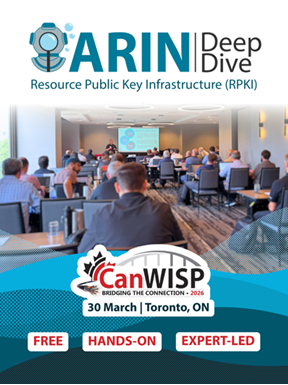
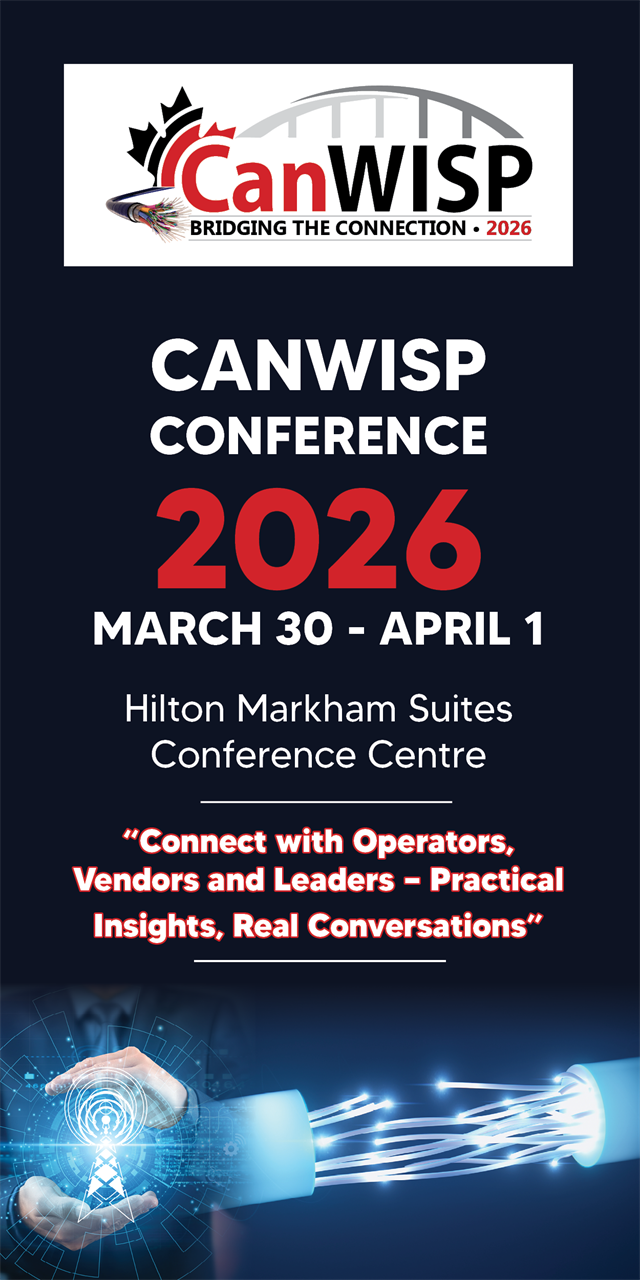 The upcoming CanWISP Conference in Markham is shaping up to be our most dynamic and well-attended event yet, bringing together independent ISPs, network operators, vendors, and policymakers from across Canada. This year’s program is designed to reflect the evolving nature of our industry, with a strong focus on practical, operator-driven discussions around fibre deployment, fixed wireless innovation, spectrum policy, and the real-world challenges of building and sustaining networks in rural and underserved communities.