
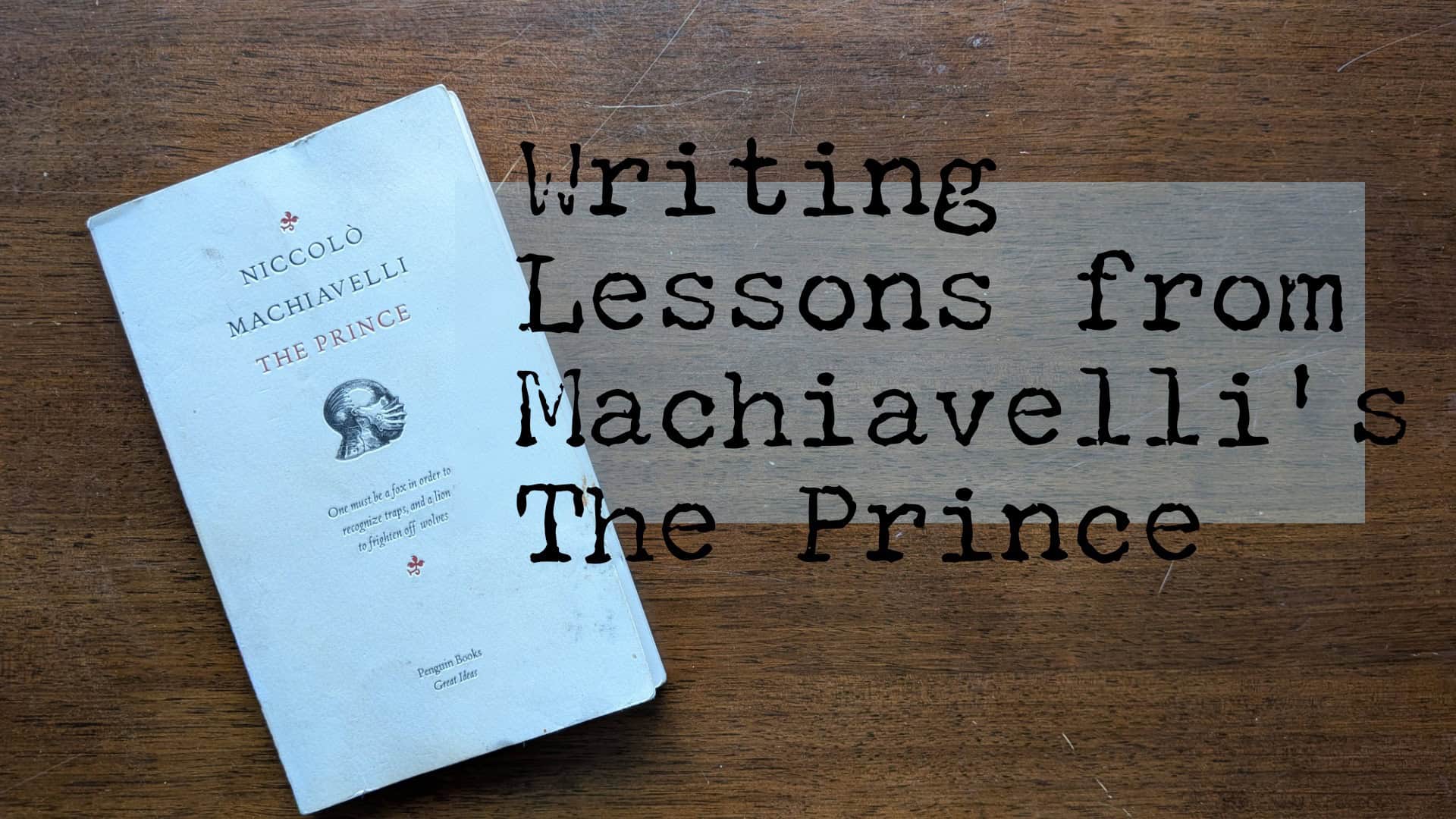
Machiavellian is not a term I hear a lot of writers using to describe their career strategies. But they should be. We understand “Machiavellian” to mean achieving goals by cunning, scheming, and unscrupulous methods. Which sounds very mustache-twirly, doesn’t it? Unscrupulous. It’s impossible to pronounce it without at least waggling your eyebrows a bit.
Because the pursuit of stories often comes from a place of heroism—we do this for the good of mankind, to correct social wrongs, even if those wrongs are just not enough stories we like to read—I think it may go against our instincts to use Machiavellian means to achieve our storytelling goals.
We’re the heroes—and Machiavellian means are for villains.
Thing is, Machiavelli’s text wasn’t written to train up evil leaders. He wrote it to talk about effective ones. He’s actually one of a long list of ghosts who are no doubt bemused to watch their name getting famous because of what they treated as one of their lesser works. If Machiavelli had not written The Prince, we would have associated his name with hyper-detailed and exhaustively historically defended apologetics for republican idealism, if we remembered his name at all. But because he felt compelled to write an essay on leadership to Lorenzo de Medici, probably because he was too skint to afford a present, we have this tidy little book about being an effective ruler. And because he does on every fifth page advise his reader to just kill the opposition, we invented the term Machiavellian to talk about being unscrupulous.
But was he? And more importantly, what writing lessons can we glean from Machiavelli’s frequent advice to kill the clergy?
Learn, Learn, Learn—Practice, Practice, Practice
“You are bound to meet misfortune if you are unarmed,”–Niccolò Machiavelli
Machiavelli advised the importance of logistics. Go figure, right? His advice to princes repeated two themes: whatever preparation you think you have is not enough, and don’t wait for either rainy days or opportune ones to have your preparation in place.
As writers, we must be in constant study. Because we gave our characters esoteric skills, or because the publishing industry is ever-changing, or simply because writing is the sort of skill you can perpetually improve. For lots of reasons, we should be in constant practice.
And because of the strange tempo of our careers, we can’t allow time to be our master. Our efforts, to observers, are structured by long periods of quiet with occasional bursts of frenetic activity. From the inside, we know that we are busy, even in our “downtime”. We’re drafting or editing or planning. Machiavelli’s advice would be to ensure that you are using that downtime to a purpose. Keep your goals ever-present, so that you are prepared to use those moments of frenetic activity.
Writers are “armed” with words and ideas. So ensure you’re always strengthening your armament, especially when there is no pressure to do so.
Seek Good Council but Trust Your Own Judgment
“So the conclusion is that good advice, whomever it comes from, depends on the shrewdness of the prince who seeks it, and not the shrewdness of the prince on good advice,”–Niccolò Machiavelli
You can get a lot of value from feedback. Feedback from peers is great. Environmental feedback from the community of readers is an amazing tool too. You can save yourself a lot of time and headache if you keep a finger on the pulse of the community who’ll read your stories.
There is, though, such a thing as too much feedback.
Or, rather, Machiavelli would point out that the usefulness of the feedback is in direct proportion to your own cunning.
You can steep yourself in all the feedback there is from all the experts who speak. If you permit the noise of the feedback to overwhelm your inner voice, however, you may be ruining its usefulness.
At some point, you need to refer to your own shrewdness and make your own decisions.
“The only sound, sure, and enduring methods of defence are those based on your own actions and prowess,”–Niccolò Machiavelli
Respect Luck, but Don’t Rely on It
“I believe that it is probably true that fortune is the arbiter of half the things we do, leaving the other half or so to be controlled by ourselves,”–Niccolò Machiavelli
As storytellers, the odds work against us. All the time. When you start to gain traction as a writer, it will be due to a precise convocation of circumstances, many of them beyond your control and some beyond your awareness. There will be a before and after moment in your writing career. There will probably be a bunch of them. And you probably won’t notice them. There will be a variety of switches from “striving” to “doing”.
You won’t notice them. You won’t be able to control every aspect of them either, because some details will be things like the nature of the marketplace, or the curiosity of a group of people you’ve never met, or a movie release that happens to whet an appetite that aligns with your book release. Turns of fortune will dictate aspects of transformational moments in your career.
And since you can’t control those turns of fortune, Machiavelli would advise you to put as little energy towards them as possible. Be aware of the sorts of things they might be, so that when they happen you can respond to them well. But put most of your time and energy into what you can control.
Focus on your craft, building your community ties, your sense of yourself, your education, and everything else that goes into being a writer. Then, when turns of fortune do occur, you can use them.
Maybe you are a villain, though…
So it depends how you define scruples, doesn’t it? If you define scruples as maintaining an appearance of conforming to a social ideal of politeness, then yes, Machiavelli’s means and advice does have a certain lack. It is generally considered impolite to murder the clergy and their families just because they’re rabble-rousing.
And while I am not advising any of my readers to murder clergy, their families, or their aristocratic benefactors (Machiavelli did advise quite a lot of killing), there may be a more general lesson to take from Machiavelli.
Which is that the right course is not always the popular one. There are times when a better way forward will meet with aggressive disapproval. And at times like that, it is your responsibility to use all of your guile and cunning to pursue that better way to greatest effect, even if your means might be called unscrupulous by those inside a shaking status quo.
Storytellers need a little villainy in them.